
Grasslands Solar Farm
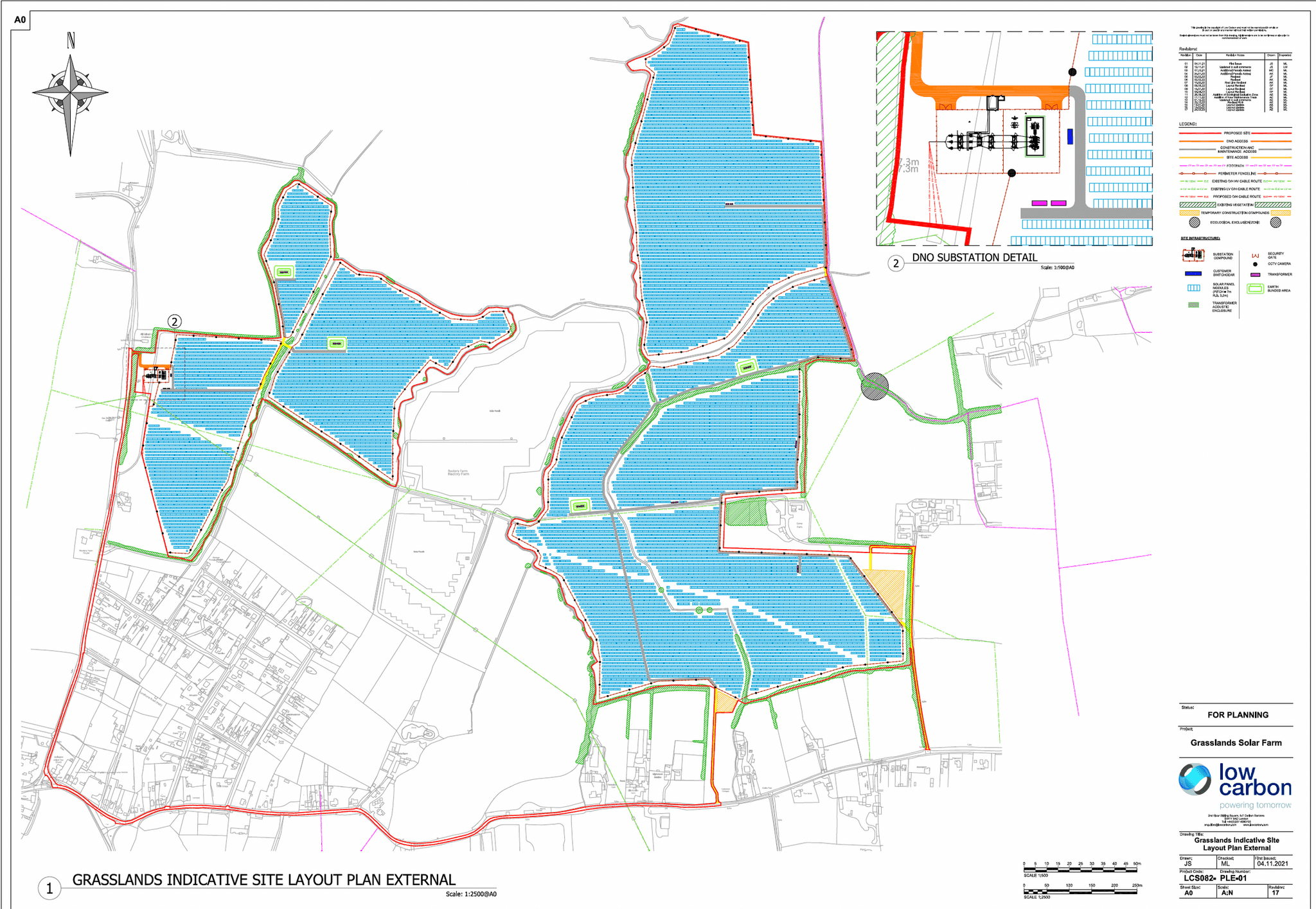
Low Carbon will be building a new solar farm, to be known as Grasslands Solar Farm, located on land to the north of Canewdon Road / Lark Hill Road, South Fambridge. The project will generate approximately 49.9 megawatts (MW), producing enough clean renewable energy to cover the annual electrical consumption of approximately 16,500 homes each year.
Welcome to
Grasslands Solar Farm
Low Carbon is bringing forward a new renewable energy project along with the infrastructure needed to export the electricity it generates to the local network operator, UKPN (Eastern).
Grasslands Solar Farm will be located on land to the north of Canewdon Road / Lark Hill Road, South Fambridge, between the Parishes of Ashingdon and Canewdon. The site will generate approximately 49.9 megawatts (MW), producing enough clean renewable energy to cover the annual electrical consumption of approximately 16,500 homes each year.
Grasslands Solar Farm is proposed for a period of 40 years, after which the modules would be decommissioned and removed from the land and as many items will be recycled or re-purposed as possible.
We want to ensure the community around this proposal is informed and fully understands the plans for the project. We encourage feedback and suggestions to help influence the design. Our project website provides a simple and transparent way for the community to provide feedback.
Timeline
- September 2021
EIA Screening
Completed 2021-11-01
- September 2022
Community Consultation
Completed 2022-09-27
- Spring 2023
Potential planning application submission to Rochford District Council
Completed 2023-05-02
- Winter 2022/23
District Council will consider and determine the application
Completed 2023-11-23
- 2024 - 2025
Pre-construction Activities
- 2025
Commencement of Construction
Additional Information
Planning reference was given by Rochford District Council on 11th January 2024, under reference 23/00407/FUL.
Benefits
Across our UK-wide portfolio of renewable energy projects, we have championed biodiversity as a critical milestone on the journey towards a low-carbon future.
Across all our solar parks we work with landowners and developers to implement comprehensive land and biodiversity management programmes. Each aligns with the conditions and circumstances unique to its site. Yet while we are pledged to protecting existing flora and fauna, most parks benefit still more from the introduction of extensive new planting and husbandry measures.
As sites mature, ongoing development will realise an increasing diversity of habitats and species: from meadows, hedgerows, wildflowers and woodland to sheep, bees, birds, bats, reptiles and invertebrates.
Biodiversity
It is important that the site is improved for nature and shows a biodiversity net gain, thus helping to protect and improve new and existing habitats whilst allowing the land to recover from a monocultural environment. We are thereby creating a species rich haven for wildlife.
Planning conditions tend to require both a Construction Environmental Management Plan (CEMP) and a Landscape and Biodiversity Management Plan (LBMP) to be submitted for approval. The former deals with the construction process measures whilst the latter deals with post-construction measures and those throughout the operation of the project.
PROW
We would look to keep the Public Rights of Way (PRoW) open throughout construction and operation of the solar farm. If possible and to maintain the enjoyment of these paths we look to include buffers of meadow or wildflower planting and a thick hedgerow to help screen direct views of the solar farm.
Beehives
We encourage the siting of beehives within the solar farm, which not only helps to pollinate nearby crops and plants but provides a secure environment with readily available food sources. The hives are tended by trained local beekeepers to ensure the health and welfare of the bees.
Sheep
At our solar sites, Low Carbon is committed to working in partnership with local landowners to provide where possible a unique and innovative space for them to graze their sheep amongst the solar panels.
Grazing sheep at our sites has proved to be hugely popular amongst our landlords for several reasons, notably because the sites are secure which means the sheep are safe and the solar modules provide shelter from the winds and shade from the sun and rain.
Planting
Our sites are designed around existing hedgerows and trees. We look
to enhance the site with additional planting of native species of hedgerows, trees, pasture-mix grasses and wildflowers.Community Benefit
Low Carbon will contribute funds to local community projects as part of our solar farm investment.